The David Lynch Compound: A Cinematic Landmark in Outpost Estates
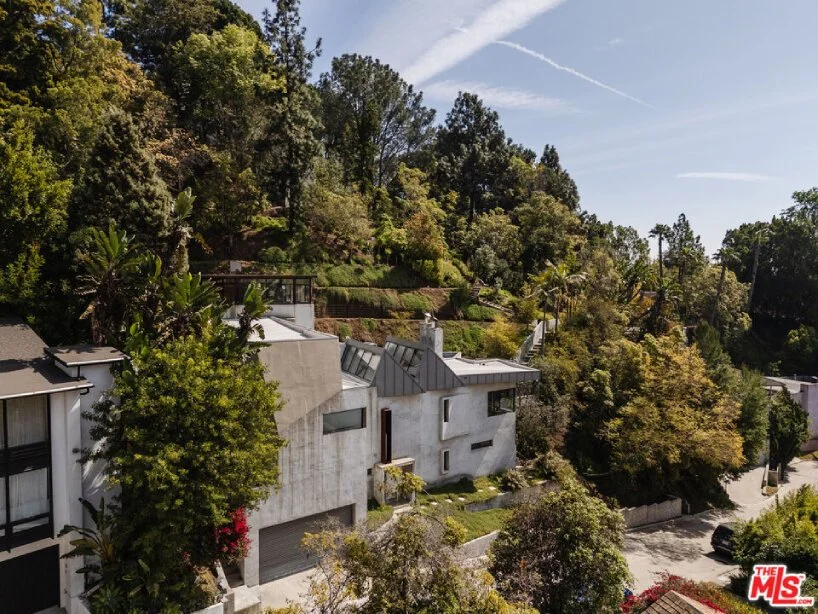
Aerial view of the David Lynch Compound spanning 2.3 acres across five contiguous parcels on Senalda Road in the Outpost Estates neighborhood of Hollywood Hills. Photo credit: Neue Focus / The Agency. Source: Robb Report
For more than three decades, one of the most celebrated filmmakers in American history called Outpost Estates home. David Lynch — the visionary director behind Blue Velvet, Twin Peaks, Lost Highway, and Mulholland Drive — lived, worked, and created on Senalda Road in the heart of our neighborhood, assembling what became known as The David Lynch Compound: a sprawling 2.3-acre creative sanctuary that blended architectural significance, cinematic history, and artistic mythology unlike any other property in Los Angeles.
The compound sold on March 2, 2026 for $13 million, closing a remarkable chapter in Outpost Estates history.
Here's the story of the man, the compound, and its deep connection to our neighborhood.
Who Was David Lynch?

Director David Lynch. Lynch lived and worked in Outpost Estates for more than 35 years. Photo credit: Valery Hache / Getty Images. Source: NBC News
David Keith Lynch (January 20, 1946 – January 16, 2025) was an American filmmaker, visual artist, musician, and actor widely regarded as one of the most important and influential directors in the history of cinema. His work was so distinctive — blending surrealism, dreamlike imagery, and dark explorations of American life — that his very name became an adjective: "Lynchian."
Born in Missoula, Montana, Lynch trained as a painter at the Pennsylvania Academy of the Fine Arts before transitioning into film. His career spanned nearly six decades and included:
🎥 Eraserhead (1977) — His surrealist debut, which became a cult midnight movie classic
🎥 The Elephant Man (1980) — A critically acclaimed biographical drama that earned eight Academy Award nominations
🎥 Blue Velvet (1986) — A disturbing noir masterpiece that cemented his reputation as an essential American filmmaker
📺 Twin Peaks (1990–91, 2017) — The groundbreaking television series he co-created with Mark Frost, which redefined serialized TV
🎥 Lost Highway (1997) — A neo-noir film partially shot at his Outpost Estates compound
🎥 Mulholland Drive (2001) — A surrealist thriller edited at his Outpost Estates studio, ranked the 8th greatest film of all time by Sight and Sound in 2022
Lynch received numerous accolades throughout his career, including a Golden Lion for Lifetime Achievement at the Venice Film Festival, an Academy Honorary Award, four Academy Award nominations, and the Palme d'Or at Cannes for Wild at Heart (1990). Beyond film, he was a painter, musician, photographer, sculptor, furniture designer, and founder of the David Lynch Foundation, which promotes Transcendental Meditation.
Lynch passed away on January 16, 2025 at the age of 78 after a battle with emphysema, exacerbated by his evacuation during the January 2025 Southern California wildfires. His family announced his passing with words that captured his spirit: "Keep your eye on the donut and not on the hole."
Lynch's Connection to Outpost Estates
David Lynch moved to Outpost Estates in 1987, purchasing a three-bedroom home at 7017 Senalda Road for $560,000. That home — the Beverly Johnson House — was designed in 1963 by Lloyd Wright, the eldest son of legendary architect Frank Lloyd Wright.
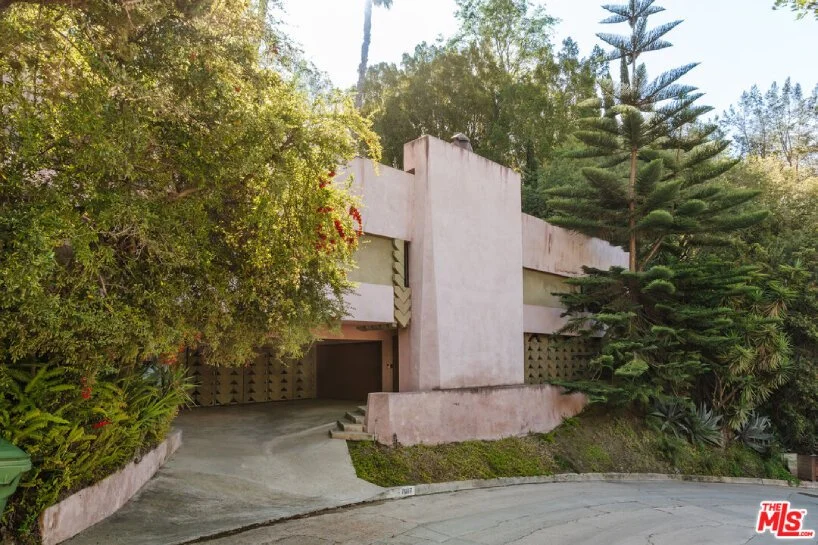
The Beverly Johnson House has been recognized by Historic Places LA as an excellent example of Mid-Century Modern/Organic residential architecture. The home features bold geometric forms, walls of glass, and a seamless flow between indoor and outdoor spaces — hallmarks of hillside modernism.
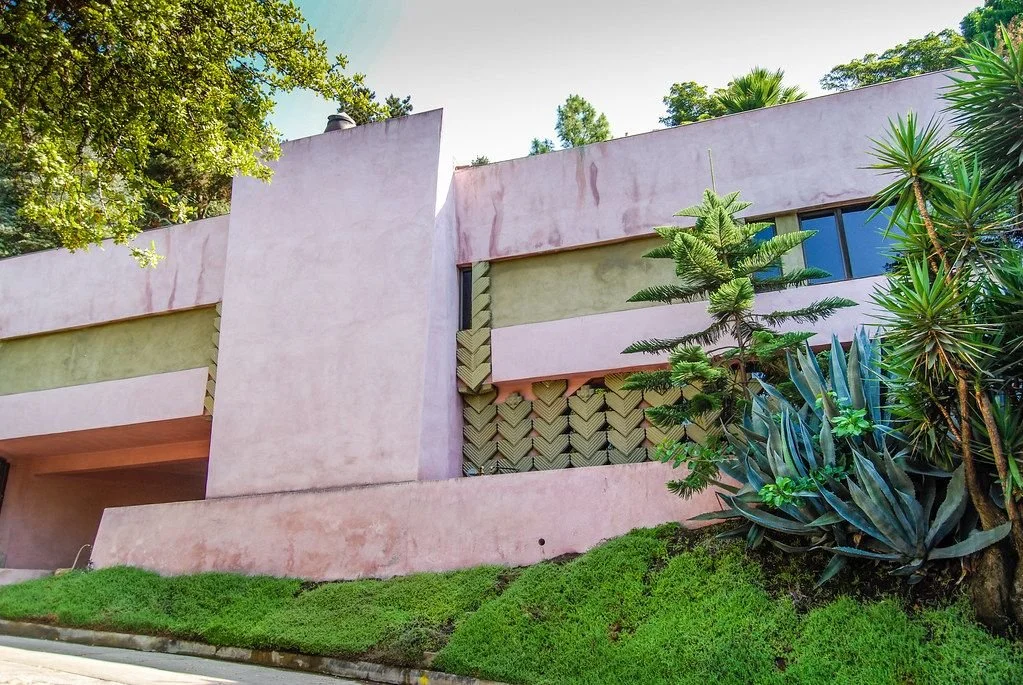
The Beverly Johnson House at 7017 Senalda Road — the heart of the David Lynch Compound — designed in 1963 by Lloyd Wright, son of Frank Lloyd Wright. The home's distinctive chevron cement facade and pink-hued concrete are hallmarks of Lloyd Wright's Mid-Century Modern/Organic architectural style. Photo credit: Neue Focus / The Agency. Source: The Hollywood Home
The property sits just below Mulholland Drive in upper Outpost Estates — a detail that takes on special significance given that Lynch's acclaimed 2001 film Mulholland Drive shares the name of the road winding directly above his home. Lynch edited the film at his compound's studio on Senalda Road, making the connection between the filmmaker and the street more than just coincidental — it was deeply personal.
Lynch himself expressed a preference for Lloyd Wright's work over even that of his more famous father. Shortly before his death, Lynch told The Wall Street Journal that Lloyd Wright's style was more to his taste, calling it "more minimal" and "more pure" while being "just as beautiful."
Building the Compound: Five Parcels, Seven Structures, 35+ Years
What began as a single home purchase in 1987 evolved over more than three decades into a five-parcel, seven-structure compound spanning approximately 2.3 acres with a total of 11,000 square feet, 10 bedrooms, and 11 bathrooms.
Here's how Lynch assembled his Outpost Estates compound:
🏠 1987 — 7017 Senalda Road (The Beverly Johnson House): Lynch purchased the Lloyd Wright-designed primary residence for $560,000. It remained the heart of the compound — featuring pink-hued concrete, chevron cement patterns, generous windows, and skylights.
🏠 1989 — 7029 Senalda Road (The Grey House / "Man Camp"): Lynch acquired an adjacent Brutalist-style two-bedroom home for $542,300. This building became the headquarters of Asymmetrical Productions, his production company.
🏠 1995 — 7035 Senalda Road (The Studio): Lynch purchased the home between his two existing properties for $346,500. This residence was immortalized on screen as the Madison residence in Lost Highway (1997) and later served as Lynch's private editing suite, screening room, and library — where he edited Mulholland Drive (2001) and other projects.
🏊 1991 — Pool & Pool House: Lynch commissioned Eric Lloyd Wright — Lloyd Wright's son and Frank Lloyd Wright's grandson — to design a pool and pool house, extending the property's rare multi-generational Wright architectural lineage.
🏗️ Additional Structures: Lynch collaborated on the creation of several more buildings, including a two-story guest house (nicknamed "The Crow's Nest"), an Art Loft, and a one-bedroom living space finished in his favored smooth grey plaster. All structures are connected through mature landscaping and well-worn pathways.
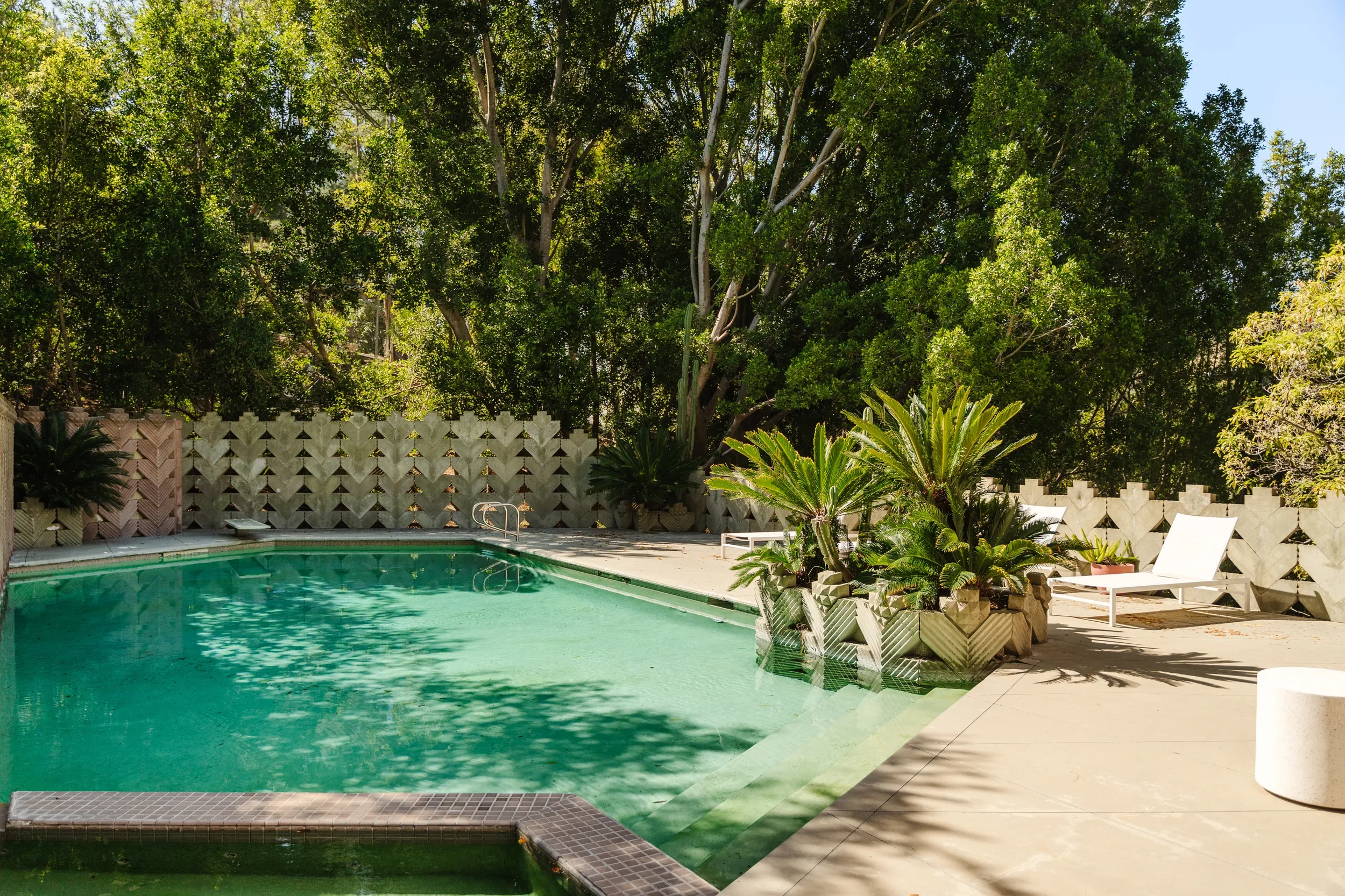
The pool and pool house at the David Lynch Compound, designed in 1991 by Eric Lloyd Wright — grandson of Frank Lloyd Wright and son of Lloyd Wright — extending the property's rare multi-generational Wright architectural lineage. Photo credit: Neue Focus / The Agency. Source: Architectural Digest
The compound became much more than a home. It was a creative campus — where Lynch lived, filmed, painted, recorded music, built furniture, and shot his popular YouTube weather reports during the early years of the COVID-19 pandemic.
As Lynch described in a 1997 interview with the German design magazine Form: the space gave him "a good feeling" and directly influenced his creative work, with shapes and details from the compound inspiring both furniture designs and films.
The Outpost Estates–Mulholland Drive Connection
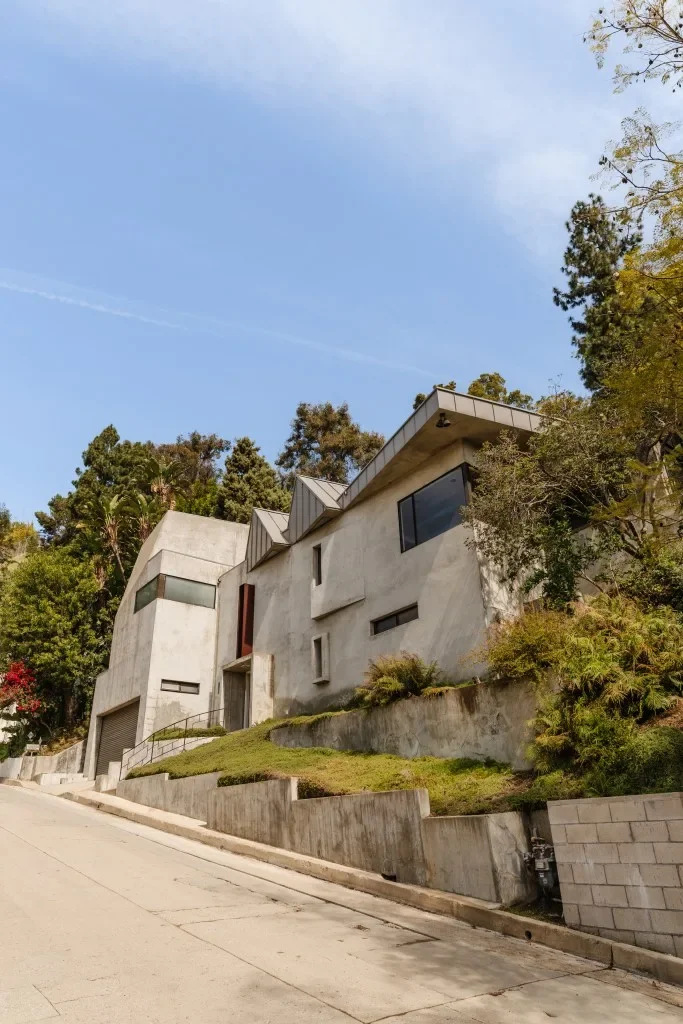
The Brutalist-style residence at 7035 Senalda Road, immortalized on screen as the Madison residence in David Lynch's 1997 neo-noir film Lost Highway. The building also served as Lynch's private editing suite, screening room, and library — where he edited Mulholland Drive (2001). Photo credit: Neue Focus / The Agency. Source: New York Post
The connection between David Lynch and Outpost Estates is perhaps best symbolized by Mulholland Drive — both the winding road that runs directly above the compound and the 2001 film that bears its name.
Lynch's compound on Senalda Road sits just below Mulholland in upper Outpost Estates. The road was a daily part of his life and landscape. When he created the darkly satirical Hollywood thriller Mulholland Drive — originally conceived as a television pilot — he edited it in the very studio on Senalda Road that overlooked the road itself.
The film, which explores themes of manipulation, betrayal, and the dark side of Hollywood ambition, was nominated for the Academy Award for Best Director and has since been ranked among the greatest films ever made.
For Outpost Estates residents, the link between the neighborhood and one of cinema's most acclaimed works is a remarkable piece of local cultural history.
Architectural Significance
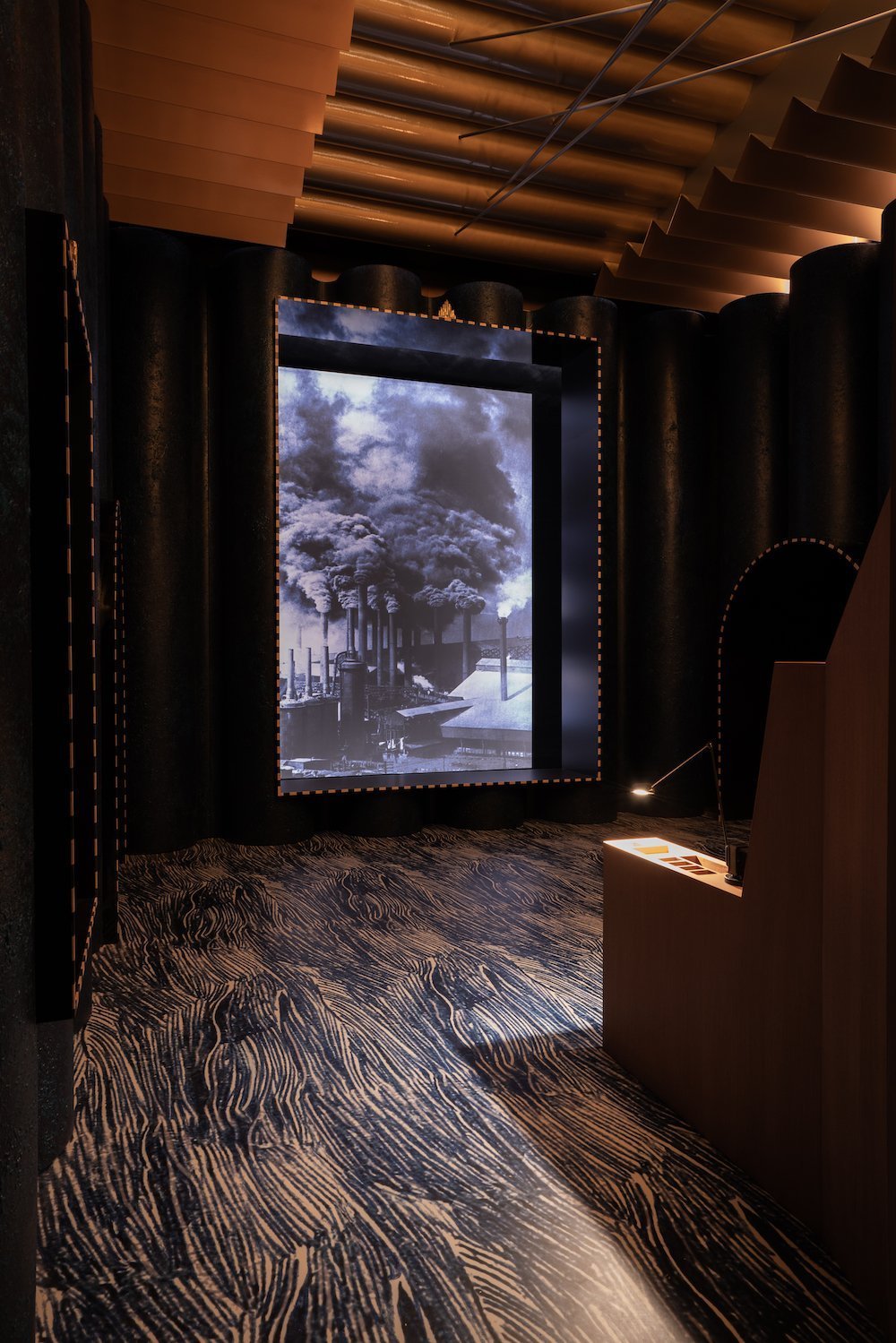
Inside David Lynch's private screening room at the compound's studio on Senalda Road. The room, draped in dark colors with acoustic equipment and recording gear, is where Lynch screened and refined many of his most celebrated works. Photo credit: Neue Focus / The Agency. Source: Euronews
The David Lynch Compound is notable not just for its celebrity provenance but for its genuine architectural importance:
🏗️ The Beverly Johnson House (1963) by Lloyd Wright is recognized by Historic Places LA as an excellent example of Mid-Century Modern/Organic residential architecture
🏗️ The pool and pool house (1991) by Eric Lloyd Wright extend a rare multi-generational Wright design lineage — two generations of the Wright family contributing to a single property
🏗️ The studio remodel (1997) was designed by studio bau:ton (now nonzero\architecture), incorporating Lynch's own architectural vision alongside the technical requirements of a professional filmmaking workspace
🎨 Lynch personally collaborated on the design of additional structures, applying the same aesthetic sensibility he brought to his films — including his signature smooth grey plaster finish
Listing agent Marc Silver of The Agency Beverly Hills described the property as rare in combining both architectural and cultural significance, telling Galerie magazine: the compound represents something unusual — a property that is both a true piece of architecture and a piece of cultural history, with two generations of Wrights and Lynch himself shaping the space over 35 years.
The Sale
The David Lynch Compound was listed for sale in September 2025 — approximately eight months after Lynch's passing — at an asking price of $15 million. The listing was handled by Marc Silver and Barry Sloane of The Agency Beverly Hills.
The listing attracted enormous interest from fans, foundations, filmmakers, and collectors worldwide. Silver noted that the hope was for the property to go to someone who wanted to preserve it — perhaps a fan, a foundation, or a museum — and that it would be a strong candidate for historical designation.
The compound sold on March 2, 2026 for $13 million.
Well-worn pathways wind through the lush, mature landscaping connecting the seven structures of the David Lynch Compound in Outpost Estates. Photo credit: Neue Focus / The Agency. Source: Robb Report
What the Lynch Compound Means for Outpost Estates
David Lynch was not just a famous resident — he was a 35-year neighbor who chose Outpost Estates as the place to live, create, and build his life's work. His compound on Senalda Road is a testament to the kind of creative, private, and architecturally distinctive living that has defined Outpost Estates since Charles E. Toberman first developed the neighborhood in the 1920s.
The compound joins a distinguished list of architecturally significant properties in Outpost Estates, including works by Rudolph Schindler, Lloyd Wright, and other notable architects — reinforcing the neighborhood's reputation as one of Los Angeles's most important collections of residential architecture.
As the property begins its next chapter under new ownership, the David Lynch Compound remains a landmark of both Los Angeles cultural history and Outpost Estates neighborhood identity — a place where one of cinema's greatest minds turned a hillside home into a world of dreams.
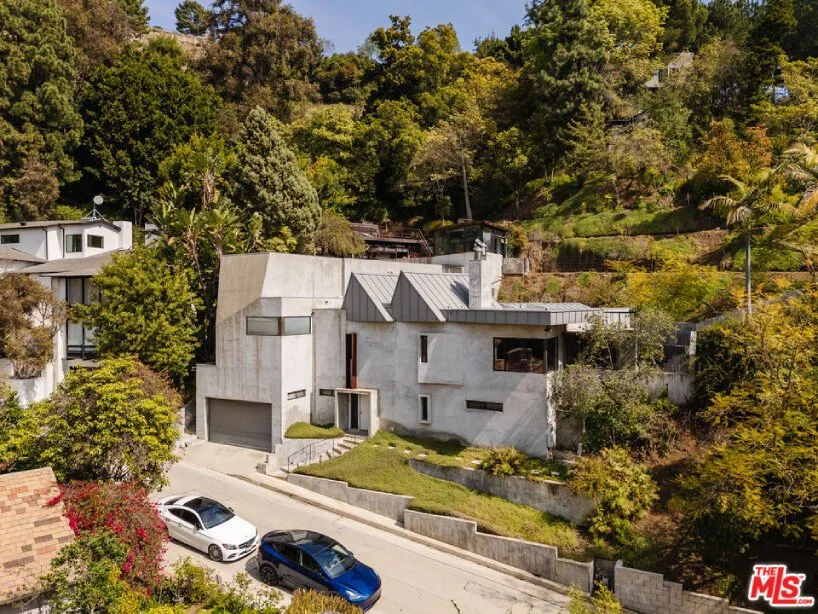
Site plan showing the five contiguous parcels and multiple structures that comprise the David Lynch Compound on Senalda Road in Outpost Estates. Photo credit: The Agency. Source: Robb Report
Sources & Further Reading
The Wall Street Journal (Katherine Clarke): David Lynch's L.A. Home
Smithsonian Magazine: David Lynch's Midcentury Compound
Robb Report: David Lynch's Hollywood Hills Compound Lists for $15 Million
Variety: David Lynch's Hollywood Hills Compound Hits the Market
The Agency Blog: David Lynch's Midcentury Compound Comes to Market
The Hollywood Home: Inside David Lynch's Landmark $15M Hollywood Hills Compound
Wallpaper Magazine: David Lynch's Wright-lineage Estate
CBS Los Angeles: David Lynch's Hollywood Hills Complex
The Architect's Newspaper: David Lynch's Compound and Studio
Welcome to Twin Peaks: David Lynch's Hollywood Hills Home For Sale
Compass (Sale Record): 7017 Senalda Rd — Sold March 2, 2026 for $13,000,000
Wikipedia: David Lynch
Galerie Magazine: David Lynch's Home Designed by Frank Lloyd Wright's Family
