Why Outpost Drive Is Classified as a Local Street — And Why That Matters
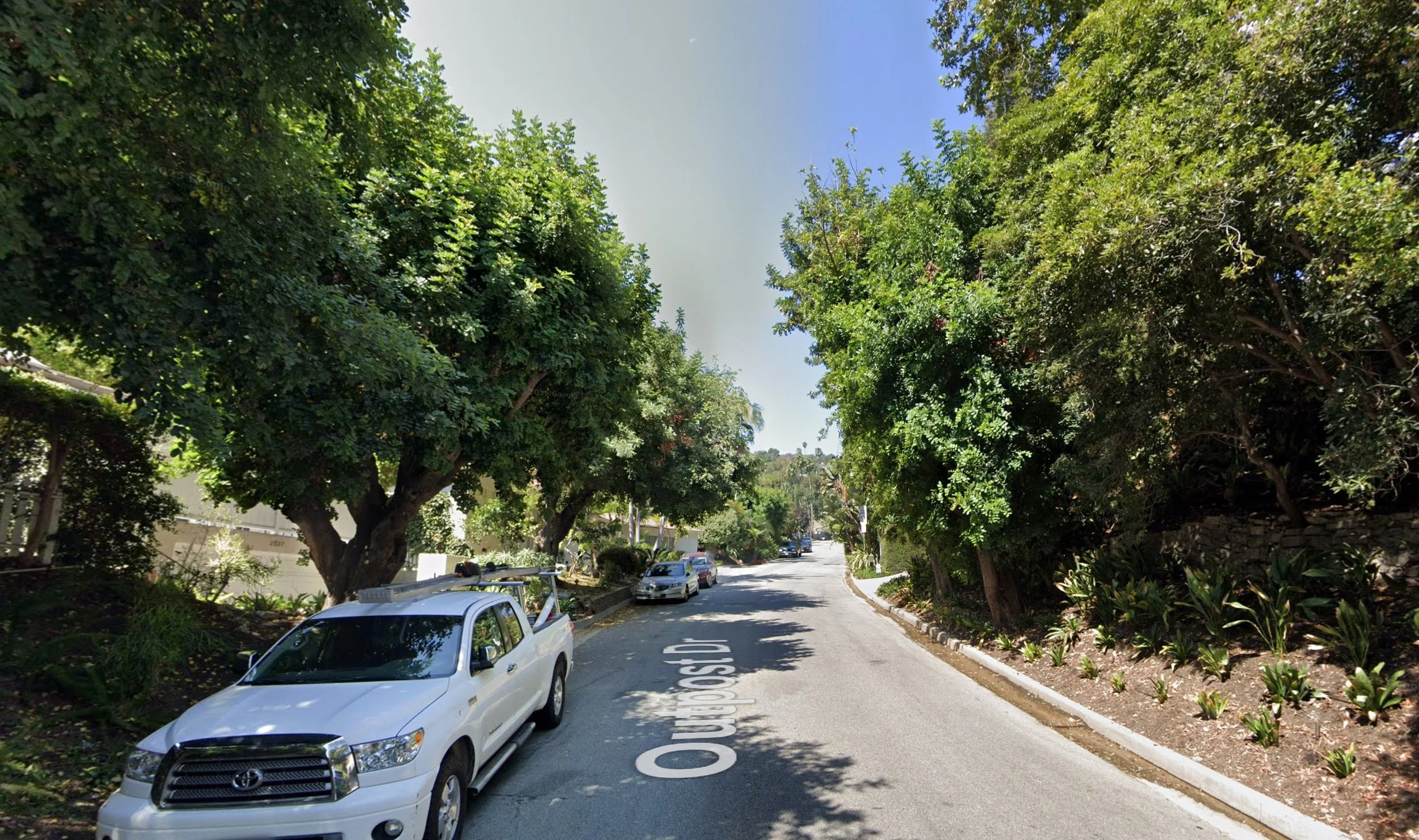
Outpost Drive is a Local Street under City of Los Angeles classification — designed to serve residents, not function as a cut-through.
Outpost Drive may feel like a tempting shortcut during busy times — especially during Hollywood Bowl events — but under City of Los Angeles standards, Outpost Drive is classified to function as a Local Street, not a collector or an arterial roadway. That distinction matters for safety, traffic enforcement, and quality of life in Outpost Estates.
This post explains what a Local Street is, how Outpost Drive fits the definition, and why the classification matters for our neighborhood.
🚦 What Is a "Local Street" in Los Angeles?
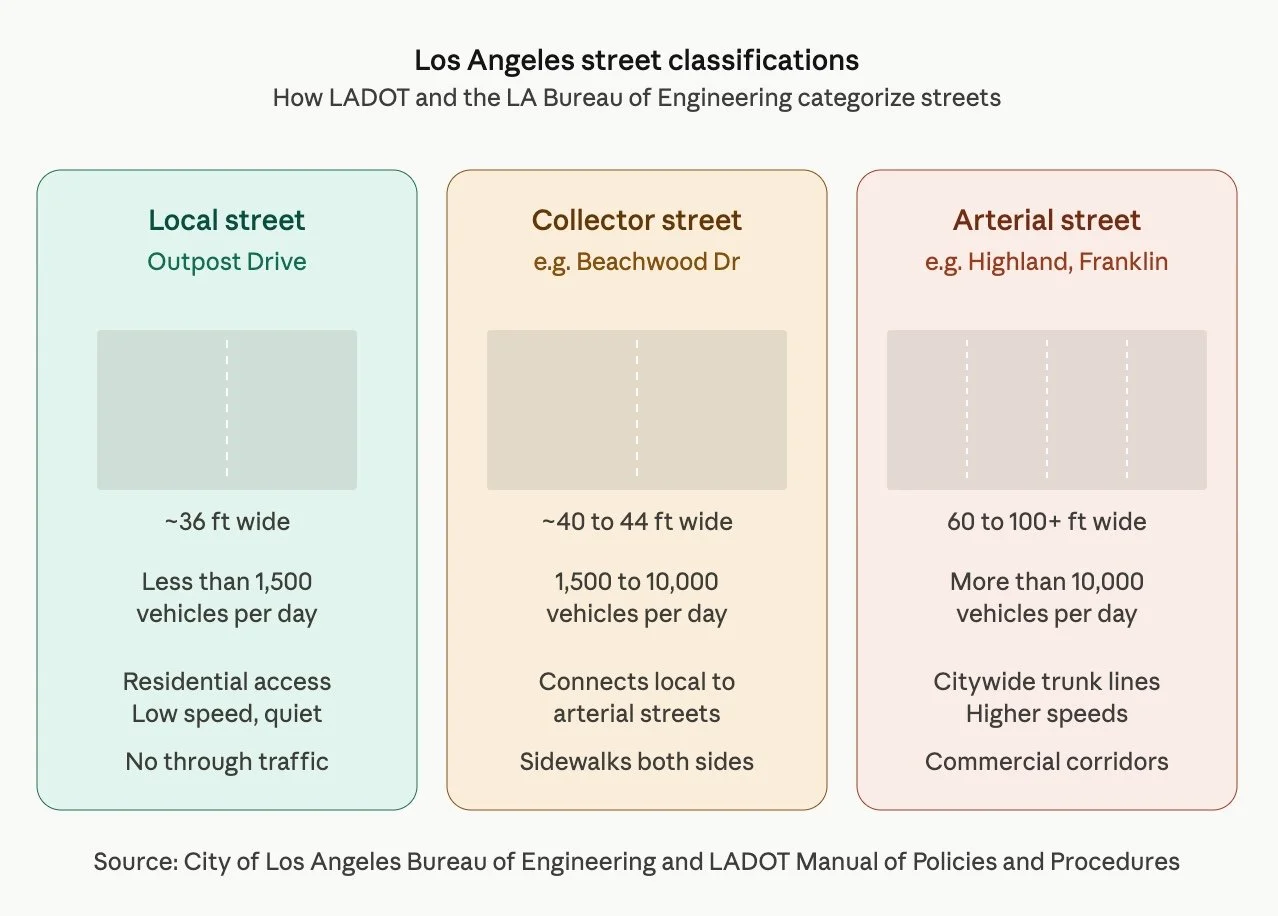
The City of Los Angeles classifies streets based on their intended function, not just how people choose to use them. The official street standards are set by the City of Los Angeles Bureau of Engineering under Standard Plan S-470-1 — Standard Street Dimensions, which was adopted in 2015 alongside the Mobility Plan 2035 and replaced the prior Standard Plan S-470-0 (adopted in 1999). These standards, together with the LADOT Manual of Policies and Procedures, categorize streets into three main types:
Arterial streets are the City's trunk lines. They carry more than 10,000 vehicles per day and provide access to major commercial destinations. Examples near us include Highland Avenue, Franklin Avenue, and Sunset Boulevard.
Collector streets carry between 1,500 and 10,000 vehicles per day and connect local streets to arterials. Standard Plan S-470 calls for Collector Streets to be 44 feet wide with 5-foot sidewalks and 5-foot parkways. Hillside Collectors are 40 feet wide with 5-foot sidewalks on both sides.
Local streets carry less than 1,500 vehicles per day and are designed to serve residential access — not through traffic. The Standard Plan dimension for a Local Street is 36 feet wide with sidewalks and parkways. Local Streets are intended to:
Serve residents and their guests
Carry low traffic volumes
Prioritize safety, quiet, and neighborhood livability
Discourage cut-through traffic
📐 Why Outpost Drive Fits the Local Street Definition
Based on Standard Plan S-470 and long-standing policy decisions, Outpost Drive aligns clearly with a Local Street designation, not a Collector or Arterial:
Street width. Outpost Drive is approximately 36 feet wide — the exact dimension specified in Standard Plan S-470 for a Local Street. Collector streets are wider (44 feet, or 40 feet for Hillside Collectors) and include full sidewalks and parkways on both sides. Outpost Drive meets the Local Street dimensions and not the Collector Street dimensions.
Sidewalks. Sidewalks exist only along the first four blocks (1800–2100 blocks) of Outpost Drive. There are no sidewalks in the 2200 to 2700 blocks — particularly uphill. This is inconsistent with collector or arterial street design, which require sidewalks throughout.
Residential context. Outpost Drive is lined with single-family homes, many of which are only 5 to 10 feet behind the face of the curb. This proximity reinforces its residential (not commuter) function and is incompatible with higher-volume street designations.
Traffic controls. Stop signs have been installed at all intersections along Outpost Drive — many by City Council ordinance over the objection of LADOT — clearly indicating that the City Council wants Outpost Drive to function as a Local Street, not as a through route.
Neighborhood traffic control measures. Existing infrastructure on Outpost Drive includes landscaped median islands to slow traffic speeds and peak period turn restrictions designed to reduce cut-through traffic during Hollywood Bowl events and rush hours. These are classic Local Street design treatments.
Speed and weight limits. The posted 25 MPH speed limit and 6,000-pound weight limit are consistent with a Local Street designed for neighborhood access — not heavy or commercial traffic.
🚗 What This Means in Practice
Re-designating Outpost Drive as a Local Street would not change its physical design and would not preclude its use by residents of intersecting streets and adjacent neighborhoods. It would merely reinforce the long-standing policy of keeping it a quiet, low-volume, safe residential street.
Specifically, Local Street status means:
Outpost Drive is not intended to function as a bypass for Franklin, Highland, or Mulholland traffic
Traffic-calming measures (such as the existing landscaped median islands and peak period turn restrictions) are appropriate and consistent with City policy
ONA has greater leverage in gaining enforcement of noise and traffic regulations related to commercial vehicles — particularly tour buses on Outpost Drive
Safety for residents, pedestrians, cyclists, and emergency vehicles is prioritized over throughput
Property values and City revenue are enhanced by reinforcing the street's residential character
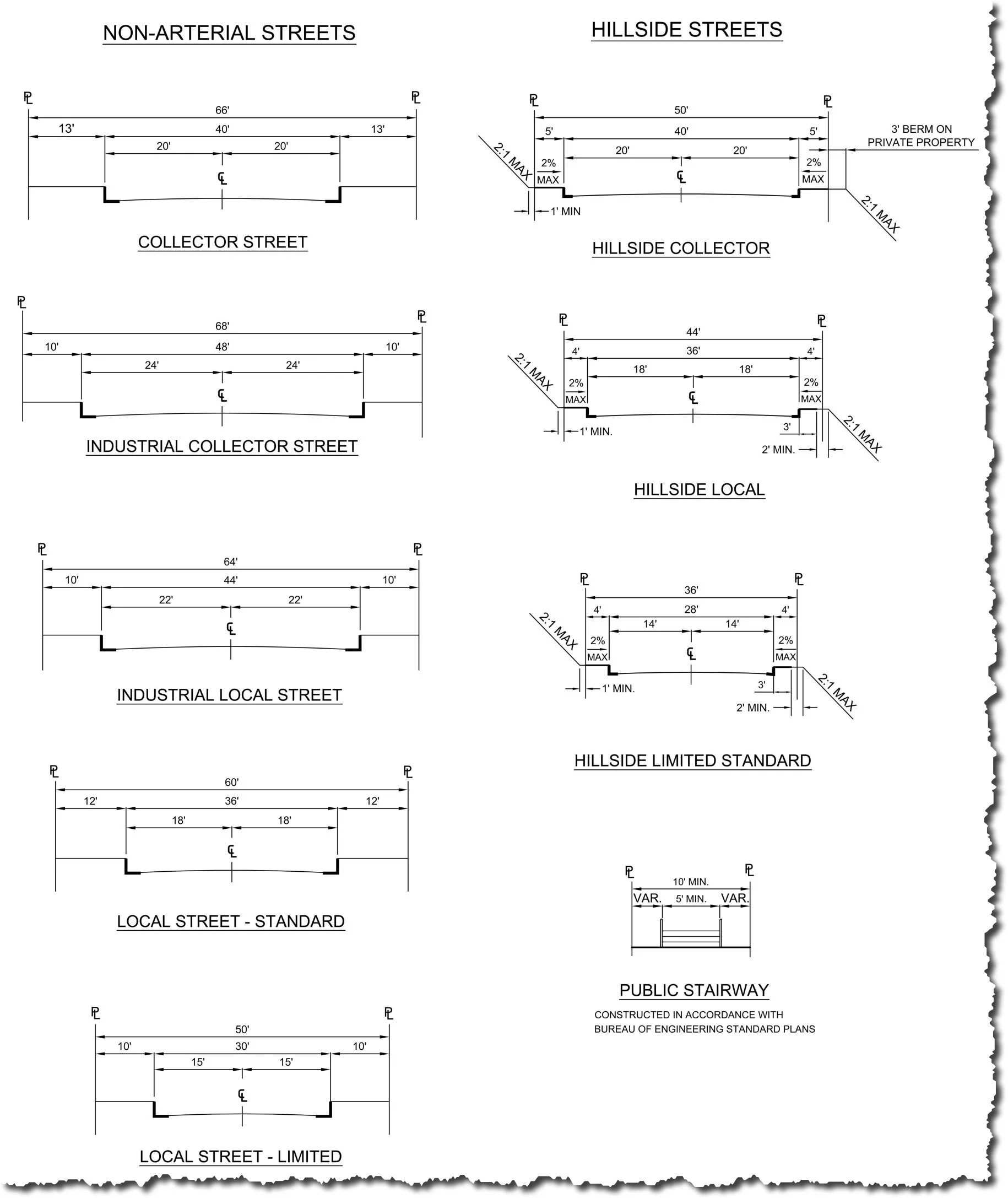
City of Los Angeles Standard Plan S-470 — Standard Street Dimensions, showing the official width and design specifications for Arterial, Collector, and Local streets. Source: LA Bureau of Engineering
🏘️ Why This Matters for Outpost Estates

Picture of Outpost Drive at Castilian Drive showing the narrow street without sidewalks and the residential character of Outpost Estates.
Outpost Estates is a historic hillside neighborhood, originally designed by C.E. Toberman in the 1920s with narrow streets and residential character in mind. When Outpost Drive is treated like a collector or arterial:
Traffic congestion increases
Emergency access becomes more difficult
Noise and safety impacts rise
Quality of life suffers
By contrast, reinforcing Outpost Drive's role as a Local Street:
Supports neighborhood safety and livability
Aligns with City design standards
Strengthens the case for enforcement against inappropriate uses (such as tour buses and heavy commercial traffic)
Helps preserve property values and the residential character of Outpost Estates
🤝 Outpost Neighborhood Association’s (ONA's) Role
Outpost Neighborhood Association continues to work with:
Los Angeles City Council District 4 (Councilmember Nithya Raman)
Los Angeles Department of Transportation (LADOT)
City Planning and Public Works staff
Federation of Hillside and Canyon Associations (the Hillside Federation)
…to ensure that policies, signage, enforcement, and infrastructure all reflect Outpost Drive's intended role as a Local Street serving a residential neighborhood — not a traffic relief valve for the city at large.
🔗 City Policy & Reference Materials
Standard Plan S-470-1 — Standard Street Dimensions (PDF) — The official Bureau of Engineering plan setting minimum width and improvement standards for all classes of public and private streets in Los Angeles. Adopted October 2015, replacing the prior S-470-0 (1999).
City of Los Angeles Complete Streets Design Manual — official LADOT/DPW reference for street types, design criteria, and classification standards
Street Classifications (E-210 to E-213) — Bureau of Engineering documentation explaining how arterial, collector, and local streets are formally categorized
LADOT Manual of Policies and Procedures — defines arterial (10,000+ VPD), collector (1,500–10,000 VPD), and local streets (under 1,500 VPD)
LA City Planning – Complete Streets Design Guide (PDF) — citywide street standards and classifications used by engineers and planners
LA Mobility Plan 2035 — the Mobility Element of the City's General Plan, establishing arterial street designations
LAMC Section 12.37 – Street Dedication — Municipal Code definitions for arterial and collector streets
LA GeoHub Street Classification Map — interactive map of City street designations
Related Posts
If you have concerns about traffic, speeding, cut-through traffic, or other issues affecting Outpost Drive's function as a Local Street, please contact ONA here.
