Outpost Estates Landscaped Traffic Islands Project
Enhancing the Safety and Beauty of Our Neighborhood

One of the current landscaped traffic islands on Outpost Drive at Castilian Drive.
Latest Update:
July 22, 2026 - Outpost Neighborhood Association (ONA) developed a notice letter that will be delivered to each home near La Presa Drive/Outpost Drive and Chelan Drive /Outpost Drive to ensure they are aware of the upcoming landscaped traffic island construction happening soon. That way, if neighbors are not on the ONA email distribution list and receive the monthly ONA emails or not on the Outpost Estates Resident Only WhatsApp chat, they recieve notice and information about the upcoming construction project. See the letter here.
July 12, 2026 - The Los Angeles Department of Transportation approved the construction traffic detour plan (view the plan here). Next step is for the pre-construction meeting to occur with LA City (anticipated to be August 2026) and then the construction contractor will mobilize the construction crew to start site work. The Los Angeles Department of Water and Power then comes to tap into the main water line for the landscape irrigation, and then construction can be completed.
Outpost Drive, our neighborhood’s main artery, has long faced dangerous motorist behaviors, endangering drivers, pedestrians, and wildlife. Originally without stop signs, motorist-to-motorist and motorist-to-wildlife collisions were frequent, but traffic calming measures including stop signs and landscaped traffic islands have improved safety.
In the late 1990’s, ONA (then “Outpost Homeowners Association”) negotiated a mitigation fee from TrizecHahn Corporation tied to the redevelopment of nearby Hollywood & Highland to address traffic safety in our neighborhood. With this funding, ONA oversaw the design and construction of five landscaped traffic islands at Castilian Drive (North and South), Hillside Avenue (North and South), and Outpost Circle which improve safety and beautify Outpost Drive. Some remaining funds from this agreement are earmarked for additional traffic calming measures.
Based on feedback gathered from neighbors through our neighborhood survey, many have expressed traffic safety to be among their greatest concerns in the neighborhood. Many also specifically want to see additional landscaped traffic islands built along Outpost Drive.
The next phase of this project will add two new landscaped traffic islands with irrigation on Outpost Drive at La Presa Drive and Chelan Place.
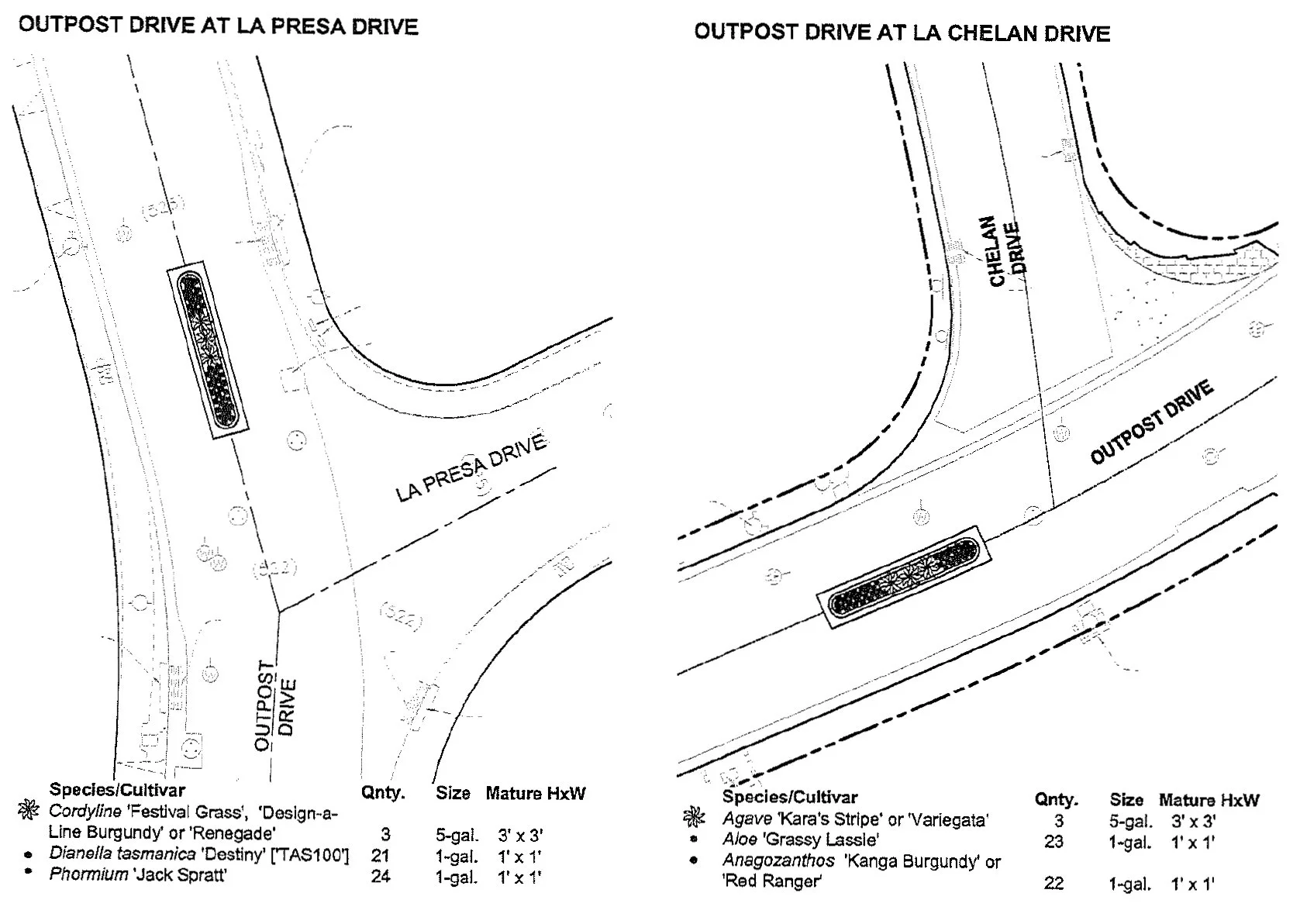
Engineered drawings of the two new landscaped traffic islands to be installed in Outpost Estates as part of the next phase of the “Outpost Estates Landscaped Traffic Island Project.”
As of July 2026, the $125,000 project is fully funded!
Current funding comes from the following sources:
$50,000 in funds from the Los Angeles County Parks Foundation Hollywood Bowl Community Grant Program (read more about it here and here).
$49,107 of funds remaining from the TrizecHahn Corporation tied to the redevelopment of nearby Hollywood & Highland which is earmarked for traffic calming along Outpost Drive.
$9,250 in funds from Outpost Estates neighbors. Ray and Dia Schuldenfrei have committed an initial donation of $1,000 both to help fund the project and to encourage others to do the same (read more about it here).
$8,938 in funds from Los Angeles City Council District 4 to cover city permit fees (read more about it here).
$7,500 in funds from NBCUniversal through a $7,500 matching grant (read more about it here).
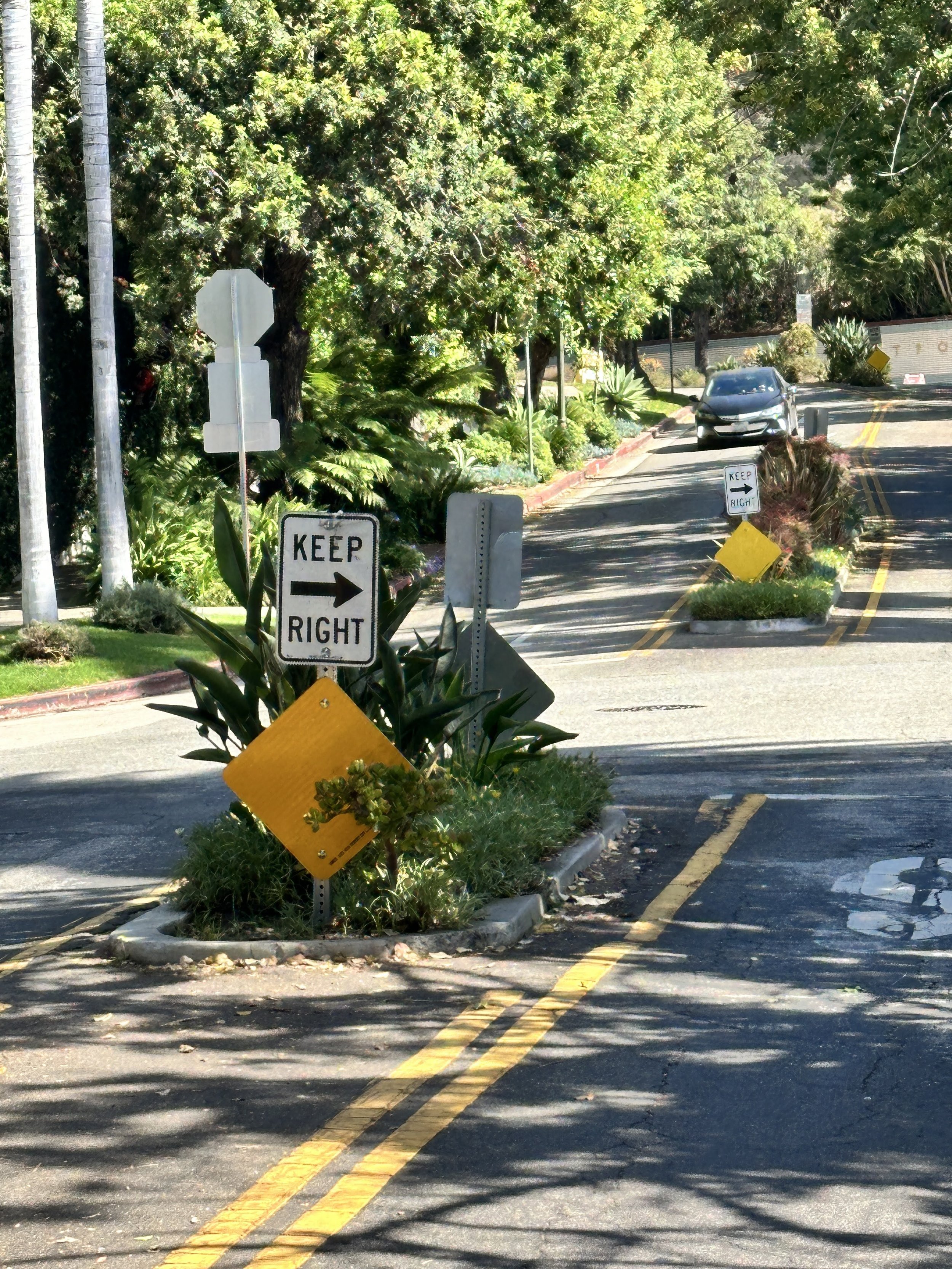
Two of the current landscaped traffic islands on Outpost Drive at Hillside Avenue.

One of the current landscaped traffic islands on Outpost Drive at Outpost Circle.

One of the current landscaped traffic islands on Outpost Drive at Hillside Avenue.
Frequently Asked Questions:
Listed below are 18 frequently asked questions and answers to those questions. If you have additional questions or feedback that are not addressed below, please reach out anytime!
Question #1: Why Build Additional Landscaped Traffic Islands?
Answer: There are six main reasons why Outpost Neighborhood Association (ONA) aims to build additional landscaped traffic islands:
Safer Intersections: Outpost Drive sees a lot of pass through traffic with people trying to avoid Highland Avenue during Hollywood Bowl events. This additional traffic increases the risk of collisions, putting drivers, cyclists, and pedestrians at risk. Outpost Drive is designated as a “local street” (read more about that here). ONA aims to reduce these risks by implementing measures that are scientifically proven to calm traffic.
Emergency Vehicle Access: During rush hours and Hollywood Bowl events, our streets become congested with additional vehicles, making it difficult for emergency services to navigate safely and quickly. By reducing the volume and speed of traffic, ONA helps ensure that ambulances, fire trucks, and police can reach those in need without delay.
Pedestrian and Cyclist Safety: From La Presa to Mulholland, Outpost Drive lacks bike lanes and sidewalks, yet it remains a popular route for those heading to Runyon Canyon Park. This creates a hazardous situation for cyclists and pedestrians. Improving this stretch will protect those who choose healthier, more sustainable modes of transportation.
Reducing Pass-Through Traffic: Many non-residents use Outpost Drive to bypass congestion on Franklin/Highland and access the 101 Freeway. This pass-through traffic not only wears down our roads but also contributes to the noise and pollution in our neighborhood. ONA desires to address this to preserve our community’s quality of life.
Enhancing Traffic Enforcement: Speeding, stop sign violations, and illegal turns are all too common on Outpost Drive. These traffic violations endanger everyone. With traffic islands, motorists will be encouraged to slow down to ensure that our streets are safer for everyone.
Question #2: How do landscaped traffic islands make our neighborhood more beautiful and safer for everyone?
Answer: Based on the past decade in which we have experienced first-hand the impact of five landscaped traffic islands that are substantially similar to the two we aim to install now, we know that these traffic islands have a significant positive impact on our community.
First, the landscaped traffic islands have led to slower average car speeds in the areas surrounding the traffic islands. The proposed additional landscaped traffic islands along Outpost Drive will provide a similar traffic calming solution, and we expect to see a measurable decrease in traffic-related incidents such as speeding, failure to stop at stop signs, and accidents between vehicles and cyclists, pedestrians, and wildlife.
As slower cars make less road-noise, we also expect to see an improvement in the quietness in the areas immediately surrounding the new landscaped traffic islands.
And, of course, we also foresee enhanced visual appeal of the street in these areas, giving a more residential feel to a street used as a cut-through during rush hour and Hollywood Bowl events.
We hope all of these intended outcomes come together to improve quality of life for residents, visitors, pedestrians, cyclists, motorists, and wildlife, even potentially positively impacting property values in the neighborhood. Any increase in property values as a result of this project would lead to an increase in property tax revenues on properties sold in the future, thereby helping to generate incremental funding for future programs and services at the city, county, and state level.
Question #3: Why aren’t speed humps or speed bumps being installed instead of landscaped traffic islands?
Answer: Most road sections in the neighborhood don’t qualify for speed humps or speed bumps due to their steepness, but Outpost Neighborhood Association (ONA) continues to pursue speed humps in areas where the slope is appropriate and other physical and traffic conditions align with LADOT’s requirements for the Speed Hump Program.
See additional information about ONA's efforts on speed humps here.
Landscaped traffic islands are a recommended traffic calming solution: they make the approach to an intersection feel narrower so people will slow down and stop, they direct drivers away from the center of the road at intersections reducing the chance of head-on collisions, and they help deter drivers from passing others who are stopped at a stop sign.
Question #4: What happened to the landscaped traffic island that was planned at Mulholland Drive and Outpost Drive?
Answer: After the Mulholland island plans were shared, a group of neighbors living in upper Outpost Estates (near Outpost Cove Drive, Carmen Crest Drive, Larmar Road, etc.) raised concerns about safety, visibility, emergency access, and overall comfort with the design.
Following community meetings, a petition, and extensive discussion, ONA made the decision to cancel the landscaped traffic island at Mulholland Drive and Outpost Drive, even though it had already been approved and permitted. Read more about it here.
Rather than doing nothing, neighbors and ONA worked together on an alternative. Instead of a physical island, ONA asked LADOT to:
Refresh and widen the yellow center striping at the intersection
Stripe the roadway to reflect the same footprint the island would have occupied
Use paint and striping as a temporary, low-impact test to see if it helps drivers stay in their lanes
This approach allows the City and neighbors to evaluate whether clearer striping alone can:
Calm traffic
Reduce wide turns into oncoming lanes
Improve safety without adding permanent infrastructure
Question #5: Who will benefit from this project?
Answer: Homeowners and renters living in the immediate vicinity of Outpost Drive along the affected road segments are the target population and will directly benefit from improved aesthetics and safety from traffic calming. The project will positively benefit the residents of all 450+ homes in Outpost Estates to varying degrees by creating increased neighborhood connectivity, safer neighborhood streets, and possibly an increase in property values. As a neighborhood in Los Angeles interconnected to the city’s open space assets, we share our community with abundant wildlife—residents get to experience frequent sightings of deer, coyotes, and more in our streets and occasionally backyards. We expect this project will also help protect the diverse wildlife by reducing the likelihood of motor vehicle collisions involving wildlife.
Motorists will benefit from safer traffic conditions including lower speeds and reduced risk of head-on collisions around tight curves with limited visibility: cars traveling in opposing directions will be directed away from the center of the road where the traffic islands are located. This includes both neighborhood residents and also commuters. For context, Outpost Drive is used daily by residents of neighboring areas and other motorists simply driving through the Hollywood area to get to their destination. Outpost Drive is used by many as a cut-through to travel between Franklin Avenue, Mulholland Drive, and the 101 to bypass Hollywood traffic, particularly near Highland Avenue where it intersects Franklin Avenue and Hollywood Boulevard. Thousands of cars travel on Outpost Drive every day—thousands more do so on the evenings of Hollywood Bowl events to circumvent added traffic in the area.
Pedestrians and cyclists in the neighborhood will also benefit from increased safety via lower motorist speeds. Currently Outpost Drive is the spine of our neighborhood for traffic flow, but because walking on segments of Outpost Drive can be so treacherous, it also effectively divides Outpost Estates into distinct pockets of pedestrian activity and thus social connectivity. ONA anticipates that traffic calming achieved by the traffic islands will increase safe pedestrian routes for residents of these pockets, greatly impacting quality of life in upper Outpost Estates and increasing neighborhood connectivity, both physically and socially.
Question #6: What is the project budget?
Answer: The engineering/designs were already paid for and completed during the first phase of the project. The remaining costs to construct the two new landscaped traffic islands is about $125,000 total (about $62,500 per traffic island). This is broken down as follows:
Services and Supplies: $125,000
This is broken down by:
$85,500 for construction,
$7,500 for water connection,
$8,000 for survey,
$8,000 for landscaping, and
$16,000 for traffic flaggers during construction.
Fees/Permits: $9,900
This is broken down by:
$9,000 for Inspection/City fees. This has already been paid by Los Angeles City Council District 4. Other fees for engineering, permits, etc. were previously paid as well.
Question #7: Why do neighbors need to help fund this project?
Answer: While city funding would be ideal, limited resources and competing projects across the city make it highly unlikely that the city would fund the project—after all, the neighborhood is nearly 100 years old and the city hasn’t built or funded any traffic islands in Outpost Estates. We need to take action in order to protect and beautify our neighborhood.
Question #8: What is the project timeline?
Answer: The project has the following phases:
COMPLETE: Engineering has been completed by KPFF. The plans are available here.
COMPLETE: Designs and Class B Permit already done and valid through 7/25/27 see here for permit.
COMPLETE: The construction contract with JF Engineering has been completed and signed. The executed contract is available here.
COMPLETE: LosAngeles City Council District 4 worked with the Los Angeles Bureau of Engineering and submitted a City Council Motion to pay for all the city permit fees for this project. CD4 did this for the first 5 traffic islands that were installed. The motion was approved by the Los Angeles City Council and Mayor Karen Bass (see here).
COMPLETE: ONA has paid the $27,000 construction Bond to the City.
IN PROGRESS: The Contractor has submitted their certificate of insurance to the city and has pulled the permits. The pre-construction meeting is scheduled with Los Angeles Department of Water and Power (LADWP) so that they can install the irrigation water connection. Once LADWP complete their steps, construction can commence.
Question #9: How has ONA kept the neighborhood informed and involved in this project?
Answer:Outpost Neighborhood Association (ONA) shares updates and gathers feedback through many different channels, not just one or two. This landscaped traffic island project has been studied, discussed, presented, shared, vetted, etc. over the past 3+ years. All neighborhood feedback is taken seriously and thoroughly reviewed and the project plan updated accordingly. Through the many years of community input and feedback, an overwhelming majority of Outpost Estates residents now support the addition of the two new landscaped traffic islands on Outpost Drive at La Presa and Chelan. Information on this project is shared with neighbors and feedback is gathered through the following eight avenues:
an annual in-person neighborhood meeting every January (where neighbors are mailed an invitation to their home in case they do not get emails or text) where the project is discussed and feedback is solicited;
bi-monthly virtual Board meetings on the second Tuesday of every other month that is open to all to participate. Agendas and minutes are all posted publically online here and the landscaped traffic island project has been a standing topic at each meeting;
special meetings held specifically on traffic and security topics held ad-hoc, like the meeting on the Mulholland traffic island here;
updates and requests for feedback through monthly email newsletters to more than 1,000 subscribers;
more immediate and interactive updates and feedback requests through a resident only WhatsApp text group with more than 275 residents;
hand-delivered notices posted to neighbors doors/mailboxes like the one here;
special mailed letters inviting neighbors to join/participate in neighborhood association activities like the one here; and
this OutpostEstates.com/news website which gets an average of 12,000 visits each year.
Anyone with questions, concerns, or other feedback is welcome to reach the Board directly at board@outpostestates.com.
Question #10: Why isn't there a formal, neighborhood-wide ballot vote on this project?
Answer: ONA is a 501(c)(3) nonprofit run by a volunteer Board of Directors, not a government agency or a traditional homeowners' association with recorded governing documents that require a ballot on individual capital projects. (The older "Outpost Homeowners Association," which did have formal dues-paying members, was dissolved in 2019.)
Instead of a single up-or-down vote, ONA gathers input continuously and from many directions, through the annual neighborhood survey, in-person and virtual meetings, a WhatsApp group, email newsletters, and hand-delivered mailers and notices, and that input directly shapes what gets built.
The clearest example is the Mulholland Drive island: after neighbors raised concerns, ONA cancelled it even though it had already been approved and permitted by the City. Homeowners directly affected by parking changes, like new red curbs, are also individually surveyed and asked to sign off before those changes move forward. Residents who want a more direct hand in these decisions are welcome to run for the Board, which is elected by the neighborhood every year.
Question #11: Who decides how ONA's funding, including outside grants, gets spent?
Answer: ONA's Board sets project priorities based on the recurring feedback gathered from residents, including a neighborhood survey in which traffic safety was consistently ranked among the top concerns. Much of the funding for this project isn't general-purpose money the Board can redirect at will. The TrizecHahn Corporation funds date back to a 1990s mitigation agreement and are earmarked specifically for traffic calming along Outpost Drive, and the Hollywood Bowl Community Grant, the Los Angeles City Council District 4 funds, and the NBCUniversal match were each awarded for this specific project. As with any project decision, residents can weigh in through the channels described above, and ultimately through who they elect to the Board each year.
Question #12: Can the plant selection be changed after the islands are built?
Answer: The plant palette in the approved plans went through the City's design review and permitting process, so it can't be swapped out during construction. Once a traffic island is complete and accepted by the City, though, ONA can explore changes to the landscaping, the same way plantings on the five existing islands have been refreshed over time. Residents who would like to see a different look for the new islands are welcome to share ideas through the usual channels once construction wraps up.
Question #13: Why were these specific locations chosen, and could an island go on a different corner of an intersection instead?
Answer: Every intersection along Outpost Drive was studied by KPFF's traffic engineers and reviewed by the Los Angeles Department of Transportation (LADOT), and not every corner has enough room for a median. Available right-of-way width, sightlines for drivers, the turning radius vehicles need, existing utilities, and the impact on adjacent homeowners' parking all factor into which spots are actually feasible. That review is what narrowed this phase of the project down to La Presa Drive and Chelan Drive. Mulholland Drive was also studied and approved but was later cancelled after neighbor feedback, as described in Question #4 above.
Question #14: Why not just paint or stripe the intersection instead of building a physical island?
Answer: A raised, landscaped island is what actually stops a car from cutting into the oncoming lane or drifting toward the center of the road. Paint alone doesn't physically block that movement the way a curb does, which is why ONA's first five islands, and this next phase, use a raised design rather than paint. Mulholland Drive is the one exception, where paint and striping are being tested precisely because the physical island there raised separate visibility and access concerns unique to that corner (see Question #4).
Question #15: Will this project remove street parking?
Answer: A small number of parking spaces right at the corner will become red-curb no-parking zones, which is standard for any median so drivers have a clear sightline and enough room to turn. The homeowners immediately next to these changes were individually shown the plans and asked to sign off before the project moved forward. Parking further from the corner isn't affected.
Question #16: Do residents have to pay anything for this project?
Answer: No. ONA has no authority to charge mandatory dues or assessments. Funding comes from grants (the Hollywood Bowl Community Grant Program, NBCUniversal, Los Angeles City Council District 4) plus funds remaining from a 1990s developer mitigation agreement with TrizecHahn Corporation, along with voluntary donations from neighbors who choose to contribute. No resident is required to give anything toward this project.
Question #17: Who maintains the islands after they're built, and what happens if one is damaged?
Answer: ONA maintains the landscaping and irrigation on all of Outpost Drive's traffic islands, at a cost of roughly $60 a month per island, funded through ONA's operating budget. Structural damage to the curb itself, say from a vehicle collision, would be handled through the City's standard process for damage to public infrastructure.
Question #18: Is it still possible to stop or change this project at this point?
Answer: This phase has already been fully engineered, permitted, and funded, with a signed construction contract and the required City bond paid, so it's moving forward. As the Mulholland Drive example shows, ONA does take new, substantial concerns seriously. But the review this project has already been through means there isn't a mechanism to cancel it simply because some residents would prefer it not be built. Residents who want a stronger voice in which projects ONA takes on next are welcome to attend meetings, participate in one of the many different avenues to provide feedback as outlined in Question # 9 above, or run for a Board seat, which is elected every year.
